
Jump To Section
- 1 Why Resolution Still Fails in Most Many Telecom Digital Journeys
- 2 The Shift From Self-Service to Self-Resolution
- 3 What AI Changes in Telecom Experience Design
- 4 Where AI Guardrails Matter in the Telecom Journey
- 5 Measuring Improvements and Success in Digital Resolution
- 6 Final Takeaway: The Next Phase of Telecom Digital Experience
For more than a decade, telecom operators have invested heavily in mobile apps and expanding digital self-service channels to improve convenience and reduce service costs. Customers can check usage, review billing details, manage plans, and browse support content without contacting an agent.
But many of those experiences still fail to resolve issues end-to-end: a customer may be able to identify a problem in the app or portal yet still need to switch channels to solve it. They might find an unexpected charge, but not the cause. They might complete the first steps of troubleshooting but still need to call support. They might explore plan options but fail to finish the change digitally.
That gap creates a business problem. When digital journeys do not fully resolve customer issues, demand shifts back to assisted channels. Contact volume rises, handling times increase, and service teams absorb work that digital channels were supposed to prevent.
AI-assisted experiences are changing the design conversation; the opportunity is not just to make support interactions faster. It is to redesign telecom journeys so digital channels can move customers from question to resolution with less friction and fewer handoffs.
This article examines the shift from self-service to self-resolution in telecom. It outlines why many digital journeys still fail to close the loop, where AI can play a practical role in resolving customer issues, what guardrails matter as automation expands, and how providers can measure whether these experiences are truly reducing support demand.
Why Resolution Still Fails in Most Many Telecom Digital Journeys
Most telecom apps and portals are structured around internal functions such as billing, usage, plans, devices, and support. That structure may reflect how the business operates, but it does not always reflect how customers think.
Customers do not arrive with category labels in mind. They arrive with immediate problems:
- Why is my bill higher this month?
- Why is my service unstable?
- Why did my device fail to activate?
- Can I change my plan right now?
When digital channels are organized around systems instead of customer intent, users must translate their problem into the company’s navigation model. That adds effort before the real task even begins.
Even when a customer finds the right page, many journeys still break down before resolution. The experience may explain the issue without offering a next step. It may present a recommendation without enabling action. It may require the customer to restart in chat, on the phone, or with a retail associate to complete the task.
This is the core limitation of traditional self-service. It often supports discovery, but not closure.
The Shift From Self-Service to Self-Resolution
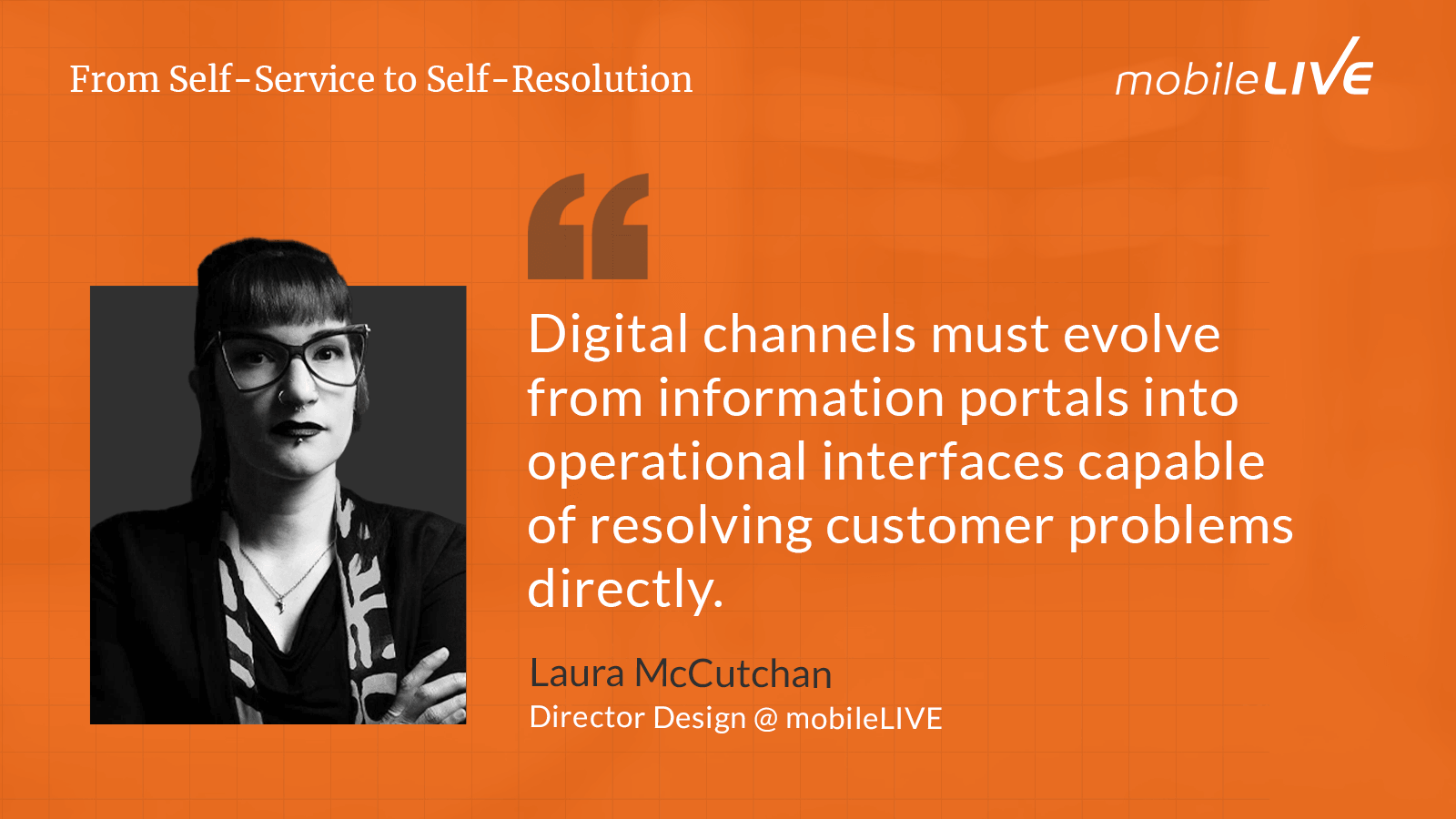
For telecom providers, the next stage of digital design is not about adding more informational tools but about building journeys that resolve customer issues end to end.
Self-resolution means the customer can complete the task inside the digital channel with clarity and confidence. The journey identifies the issue, explains what is happening, presents valid options, executes the selected action, and confirms the result.
That design approach matters because it connects customer experience goals with operational outcomes. A digital journey that actually resolves the issue can reduce repeat contacts, lower channel switching, and ease pressure on service teams.
Not every journey has equal impact. The highest-value opportunities usually sit in a small number of recurring service scenarios, such as:
- billing questions and disputes
- service troubleshooting
- activation and onboarding issues
- upgrade and plan-change decisions
These journeys matter because they combine high customer urgency with high support demand. When they fail digitally, the cost moves directly into assisted service operations.
What AI Changes in Telecom Experience Design
AI is changing telecom digital channels by moving them beyond conversational support and toward guided action. The important shift is not that customers can now type questions into a chat interface. It is that AI-assisted systems can help interpret context, recommend the next step, and support execution inside the journey.
That changes the role of the digital channel. Instead of acting only as a front-end layer for information retrieval, it starts to function as an operational interface for issue resolution.
From chat interfaces to operational assistants
Early AI assistants in digital channels were designed to answer questions. They retrieved help content, surfaced basic account information, or redirected the user to a support path. That model improved access to information, but it did not always reduce effort. Customers still had to navigate multiple systems, repeat context, or switch channels to complete the task.
The next stage is more operational. AI-assisted experiences can now help users move through a resolution flow by interpreting intent, narrowing options, and connecting the customer to the right action path. In a telecom setting, that might mean helping a customer understand a billing change, guiding a troubleshooting sequence, or identifying the valid next step in a plan-change journey.
The distinction matters because answering a question is not the same as resolving an issue. A digital experience creates more value when it reduces the number of steps between problem recognition and completed action.
A simple maturity model for AI-assisted telecom journeys
One useful way to think about AI in telecom experience design is through maturity levels.
Level 1: Informational assistance
At this stage, AI helps retrieve content or answer straightforward questions. It improves search and makes digital channels easier to use, but it does not change the underlying workflow.
Level 2: Contextual guidance
Here, AI uses customer or journey context to guide the next step. It may interpret account status, identify likely causes, or narrow down relevant options. The system becomes more useful because it responds to the situation, not just the prompt.
Level 3: Assisted action
At this level, AI supports task completion inside the journey. It may prepare an action, validate inputs, summarize options, or move the customer toward confirmation. The customer still remains in control, but the process becomes more direct.
Level 4: Governed automation
At the most advanced stage, AI can trigger selected actions across operational systems within defined policy boundaries. These actions still require clear controls, escalation paths, and visibility into what the system is doing.
This maturity model helps telecom teams avoid treating all AI use cases as equal. A content assistant, a troubleshooting guide, and an action-capable digital workflow do not create the same business value or carry the same operational risk.
Where AI can create practical value in telecom journeys
The strongest use cases are usually tied to recurring service scenarios where customers need clarity and action at the same time.
In telecom, examples include:
- network troubleshooting: helping the customer move through a guided diagnostic path based on account, device, or service conditions
- plan adjustments: surfacing relevant plan options, eligibility conditions, or change impacts based on the customer’s current account state
- billing support: helping explain charges, identify likely causes of changes, and direct the customer to an appropriate next step
- activation and onboarding: reducing friction when a device, service, or account setup process fails
These use cases matter because they sit close to both customer frustration and service cost. When they work well, they reduce unnecessary channel switching and make digital journeys more complete.
Why backend connectivity matters
AI does not create resolution on its own. It depends on whether the digital experience can connect to the systems that determine the outcome.
In a telecom environment, that often means integration with billing systems, CRM platforms, diagnostics tools, provisioning services, authentication controls, and other operational platforms. APIs make that interaction possible by allowing the digital experience to retrieve data, validate eligibility, initiate actions, and return status updates inside the journey.
Without that connectivity, AI may still sound helpful, but it cannot reliably complete the task. It can explain, suggest, or summarize, yet the customer still ends up in a dead end or a handoff.
That is why telecom teams should evaluate AI use cases as orchestration problems as much as interface problems. The customer sees one interaction. Behind that interaction, the organization has to coordinate systems, rules, and operational logic that make resolution possible.
For a detailed look into how telecoms can mdoernize with AI-assisted actions, this article offers profound and critical insights for telecom leaders.
Designing for Problem Resolution with Control
As AI becomes more action-capable, the design challenge becomes more complex. Teams need to decide which actions can be automated directly, which require confirmation, and which should remain with human support.
This is especially important in journeys that involve billing outcomes, account-level changes, or identity-sensitive actions. The interface should make the proposed action clear, show the next step, and preserve a clean path to escalation when automation cannot complete the task.
The goal is not to automate every interaction. It is to use AI where it shortens the path to resolution without creating confusion, risk, or loss of control.
Where AI Guardrails Matter in the Telecom Journey
As telecom providers introduce more AI-assisted actions, they need clear boundaries around what the system can do.
Some actions may be safe to automate directly. Others may require customer confirmation. Some may still need human review because of financial sensitivity, identity concerns, or business rules that are too complex for full automation.
Without clear action boundaries, automation can create confusion instead of reducing effort.
Customers also need visibility into what the system is doing. If an AI-assisted experience recommends an action, the customer should understand what is being proposed and what will happen after they confirm it. Clear labeling, explanation patterns, and confirmation steps help build trust in the journey. Read more on how telecoms can design transparent AI experiences that build loyalty amongst customers in this article.
Escalation design matters as well. Not every issue should stay digital, and not every exception can be resolved automatically. But when a handoff is necessary, it should feel continuous. The context gathered in the digital journey should move with the customer so the next channel does not restart from zero.
Good escalation design is part of self-resolution. It prevents a difficult case from turning into a fragmented one.
Measuring Improvements and Success in Digital Resolution
Many organizations still measure digital success through adoption and engagement. Those signals matter, but they do not show whether the customer’s problem was actually solved.
For telecom providers, the stronger measures are the ones tied to resolution. Depending on the journey, that may include:
- self-resolution rate
- digital completion rate
- assisted contact reduction
- repeat contact rate
- escalation rate
- time to resolution
These measures give teams a better view of whether digital experiences are reducing operational demand or simply shifting effort between channels.
Trust should also be part of the evaluation. A technically complete workflow still fails if customers do not understand it or do not feel confident using it. The best digital journeys combine task completion with clarity, control, and visible progress.
In 2026, telecom customer experience will be guided by five trends. Learn about them in detail here.
Final Takeaway: The Next Phase of Telecom Digital Experience
Telecom digital channels are moving beyond self-service. The next phase is self-resolution: experiences designed to solve customer issues directly, not just describe them.
That requires a different mindset. Teams need to prioritize the journeys that generate the most friction and support demand. They need to connect design decisions to the systems that determine whether an action can actually be completed. And they need to use AI where it improves the path to resolution, not where it simply adds another interface layer.
The goal is not to make digital channels more informative. It is to make them more decisive.
When telecom providers design around resolution, they improve the customer experience and create a more efficient service model at the same time.
The future of telecom digital experience will not be shaped by how much information providers can surface but by how well they help customers solve real problems. The winners will be the providers that design digital channels to resolve, not just respond.