
Jump To Section
Your AI program has a budget. It has a roadmap. It probably has a pilot or two that looked promising in a controlled environment.
And yet, somewhere between the proof of concept and production, the value disappeared.
You’re not alone. Deloitte’s 2025 AI survey of 1,854 senior executives confirms the pattern: 85% of organizations increased their AI investment in the past year, and 91% plan to increase it again.
Still, only 6% saw payback within one year. Most report ROI materializing within two to four years, far beyond the 7-to-12-month window executives expected when they approved the budget. According to RAND Corporation, more than 80% of AI projects fail outright, which is twice the failure rate of non-AI technology programs.
The usual instinct is to look at the model; to question the technology, the team, or the vendor.
That is the wrong place to look.
In this article, we dissect the true source of AI failure in financial services. Most often a governance failure, financial institutions often report that the model is working as designed. What we find is that the data environment beneath it that was never built to carry the weight of operational decisions. Additionally, the accountability for that environment – who owns it, who governs it, who has the authority to fix it – has never been formally assigned at the leadership level.
That is the accountability gap. And it is quietly the most expensive problem in your AI program.
The Biggest Challenge of Building Scalable AI in Banking
The hardest part of scaling AI in financial services is not selecting models or procuring platforms.
It is building the data foundations those models can trust.
According to a 2024 Gartner AI Survey, only 48% of AI projects make it past the pilot stage, taking an average of 8 months from prototype to production. At least 30% of GenAI projects will be abandoned after proof of concept due to poor data quality and inadequate risk controls.
When an AI system recommends a credit action, flags a suspicious transaction, or prioritizes a customer interaction, the output is inseparable from the data environment that produced it.
AI systems inherit every characteristic of the environments they operate within. Inconsistent definitions, unclear lineage, and weak governance are not cleaned up before the model runs but are encoded directly into the model’s outputs.
This creates a specific failure pattern that repeats across financial institutions: a pilot succeeds on clean, curated data in a controlled environment, then fails in production because production data is ungoverned, semantically inconsistent, and untraceable. The model gets blamed, but the real cause is the data foundation.
The consequences for financial institutions are specific and measurable:
- Credit decisions slow down or produce inexplicable adverse actions because the model is reasoning on inconsistent customer risk definitions across origination, servicing, and collections systems
- AML false positive rates remain high because transaction monitoring models are trained on definitions of ‘suspicious’ that differ between the surveillance team and the risk team
- Customer servicing AI produces inconsistent outcomes because ‘active customer,’ ‘eligible product,’ and ‘at-risk account’ are defined differently across the CRM, the core system, and the marketing platform
- Underwriting models are challenged in exam because the institution cannot reconstruct which data version, which definition, and which transformation produced the recommendation
- Personalization programs stall because the customer data product feeding the recommendation engine is not trusted by the business owners who are supposed to act on it
To understand the AI pilot purgatory trap that financial services face, and how to approach it in 2026, read this article.
None of these are model problems; they are data foundation problems, and they can’t be solved by upgrading the model.
The Accountability Shift Nobody Planned For
For years, data teams were responsible for moving and preparing data. Their success was measured by pipeline uptime, warehouse reliability, and dashboard refresh rates. They produced inputs. Business teams interpreted outputs. Accountability for decisions stayed with the people making them.
That operating model no longer reflects how AI-driven decisions are made.
Today, the pipeline is not delivering information to a decision-maker. It is participating in the decision itself. The data team is no longer in the background. It is embedded in every credit recommendation, every fraud alert, every underwriting outcome that an AI system produces.
That shift creates a structural problem most institutions have not addressed: data teams now carry accountability for decision outcomes they were never given authority to govern.
The CDO is responsible for the integrity of AI-influenced decisions, but may not have a seat in the room where AI deployment decisions are made. The data team is expected to deliver decision-grade outputs, but is still measured on infrastructure metrics from a different era.
The critical board question is not whether your data leader understands this; most do.
The question is whether the organization has formally assigned the authority to match the accountability.
Does the CDO have standing to halt a model deployment if governance conditions are not met
Are they measured on decision integrity, or on pipeline uptime?
In most institutions, the answer to both questions is no. That is a board-level design failure, not a data team performance failure.
Why Accountability is an Urgent Banking Problem in 2026
Two developments are making this problem significantly more urgent for banking and insurance leaders in 2026: the rise of agentic AI and the arrival of binding regulatory deadlines.
Either one alone would justify treating data governance as a board-level priority. Together, they make inaction a strategic risk.
1) Agentic AI Converts Data Shortcuts Into Operational Risk
When your institution deployed its first agentic AI system, it also, without realizing it, automated every data shortcut it had accumulated.
Inconsistent definitions. Missing lineage. Permissive access controls. In a human-driven environment, these were manageable. Analysts compensated. Reconciliation happened. Mistakes were caught before they became decisions.
In an agentic environment, there is no human in the loop. These problems execute at machine speed, silently, at scale.
In 2025, Enterprise Management Associates (EMA) reported that only 2% of organizations with 500+ employees have no plans or interest in agentic AI, meaning deployment is effectively universal. Yet 79% of organizations without written agentic AI policies have already deployed those agents, creating a systemic governance blind spot at enterprise scale.
Three failure modes become dangerous at agent scale:
Inconsistent definitions become automated errors
A human analyst who encounters conflicting definitions of ‘active customer’ across the CRM and the risk system will pause, reconcile, and proceed. An AI agent will not. It will act on whichever definition it encounters first, at scale, with no reconciliation step. In AML transaction monitoring or credit limit adjustments, that produces material downstream harm in seconds.
Missing lineage becomes regulatory exposure
Regulators across jurisdictions (the EU AI Act, OSFI’s B-20 guidance, the U.S. FSOC’s 2024 Annual Report) are aligned on a single requirement: if an AI system affects a material decision, the institution must demonstrate how that decision was reached, including the data that informed it.
When an agent executes a multi-step workflow across five data sources with three transformation rules, the absence of column-level lineage leaves auditors looking at an output with no traceable path. That is not a technology gap. It is a governance liability that increasingly has a dollar value attached to it.
Access misconfigurations become systemic
In traditional environments, a misconfigured access permission means one analyst sees data they shouldn’t. In an agentic environment, it means an agent acts on data it shouldn’t, repeatedly, silently, across every workflow it runs. The principle of least-privilege access at the agent identity level is not a theoretical best practice. It is an operational necessity that most current IAM frameworks were not designed to address.
Agentic AI does not create new data risks. It converts the data risks you already have into automated, scalable operational failures. The time to fix the data foundation is before the agent is deployed, not after.
2) Regulatory Deadlines Are No Longer Theoretical
Banking leaders have been aware of AI governance requirements for several years. In 2026, the consequences of inaction are no longer abstract.
- The EU AI Act’s Annex III high-risk system obligations take effect August 2, 2026. For any institution operating in or serving European markets, non-compliance carries penalties of up to EUR 35 million or 7% of global annual turnover. Governance cannot be a design preference at that scale of consequence.
- OSFI’s model risk management guidance requires Canadian institutions to demonstrate ongoing monitoring, explainability, and clear accountability for model outcomes. The inability to reconstruct a material AI-influenced decision is not a remediation gap. It is a present-tense finding in the next examination cycle.
- The U.S. FSOC’s 2024 Annual Report identifies AI as a significant risk requiring enhanced oversight, signaling that federal examination scrutiny of AI decision systems is increasing.
- GDPR’s accountability principle requires that if an AI agent makes a decision affecting a data subject, the institution must know how and why. Without end-to-end lineage, that obligation cannot be met.
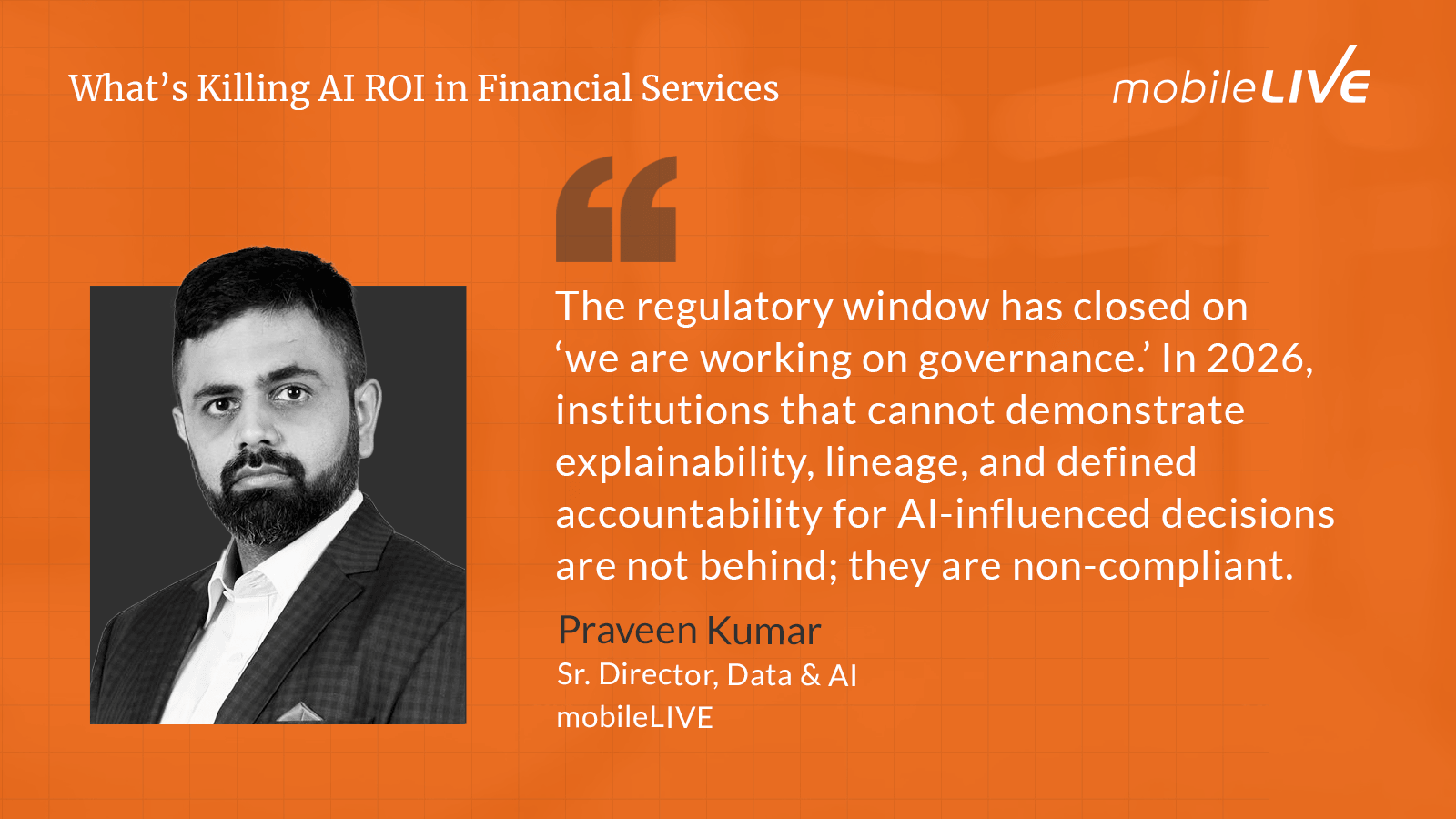
The inability to reconstruct a material AI-influenced decision is not a gap to be scheduled for remediation. It is a present-tense regulatory liability. Every AI system currently in production without end-to-end data lineage and a governed semantic layer is a potential finding. The question is not whether the scrutiny is coming but whether you will be able to respond when it arrives.
What the AI-Ready Operating Model Requires
The institutions making the most progress on AI ROI in 2026 share a common characteristic: they treat data governance not as a compliance function or a technology project, but as operating infrastructure built deliberately before scale, not retrofitted after failure.
Based on patterns we observe across financial services AI programs, three capabilities consistently separate institutions that can scale AI from those that cannot.
1. Semantic Governance: Defining What Every Concept Means
A large language model or AI reasoning engine does not process a database. It reasons about concepts, relationships, and meaning assembled from the data it is given.
When a model receives a column labeled ‘net_revenue’ from three source systems, each calculated differently, it cannot resolve the contradiction. It will choose one interpretation, average them, or produce a plausible-sounding output that is factually wrong. This is not a model malfunction. It is the data environment behaving exactly as it was left.
Semantic inconsistency is not a reporting nuisance. It is a blocker to trusted AI decisions.
The specific banking cost is real and measurable. When ‘customer lifetime value,’ ‘net exposure,’ ‘defaulted account,’ or ‘active relationship’ are defined differently across the origination system, the risk platform, the servicing system, and the analytics layer, every AI model that reasons about customers is working with structural ambiguity at its core.
The outputs will be inconsistent. And when executives encounter inconsistent AI outputs repeatedly, they stop trusting the system. AI adoption stalls, not because the technology failed, but because the data foundation undermined its credibility.
The practical response is a governed semantic layer: an authoritative, versioned registry of every business concept that AI systems reason about, owned by named individuals, linked to the platform’s data catalog, and enforced through a production gate that prevents models from deploying until the concepts they depend on have approved definitions.
Rather than a one-time data cleanup, this is a sustained operating model for governing meaning.
At mobileLIVE, we call this the Semantic Intelligence Framework: a structured approach we use with financial services clients that ties together definition governance, lineage protocol, and consumption architecture into a single operating model.
Institutions typically begin with their 20–40 highest-risk business concepts and build from there. The goal is an institution that can answer, instantly and from lineage records, what definition a model relied on, when it was last reviewed, who approved it, and what downstream systems depend on it.
Semantic clarity is now strategic infrastructure. An institution that cannot guarantee consistent definitions across its AI systems is an institution whose AI outputs cannot be trusted by executives, by regulators, or by customers.
2. Decision-Grade Data Products: What AI Systems Actually Consume
Not every dataset is fit for AI consumption. The difference matters more than most institutions realize until a model fails in production.
A decision-grade data product is not a dataset. A dataset is a collection of records. A decision-grade data product is an asset designed to be consumed by AI systems and human analysts from the same trusted source, with explicit ownership, documented semantic definitions, defined quality standards, versioning, lineage, and contractual expectations for downstream consumers.
The distinction has direct banking implications:
- A credit scoring model consuming a data product knows exactly which version of ‘income’ it is using, who validated it, and when it was last updated. A model consuming a dataset knows none of these things.
- An AML agent consuming a governed data product has formal access permission boundaries. An agent consuming raw data has whatever access was provisioned, often more than necessary.
- A compliance team auditing an AI decision supported by a data product can reconstruct the full provenance chain in hours. A team auditing a model consuming ungoverned datasets may need weeks, or may not be able to reconstruct it at all.
The question is not whether your institution needs decision-grade data products. It is how many AI systems you have already deployed without them.
3. Governance Operating Model: Who Owns What, and What Happens When It Changes
Governance is often described as a constraint. In AI-native financial services environments, it has become the precondition for autonomy.
AI agents can operate at scale only when the rules of the data environment are clearly defined and enforced. Governance codifies those rules. An institution with strong governance can deploy AI agents that execute autonomously, escalating only genuine edge cases.
An institution without governance must insert human review at every ambiguous step because the data environment cannot be trusted to be consistent.
The institutions that invested in governance are achieving more autonomy. The institutions that deferred governance are achieving less and accumulating regulatory exposure in the process.
A functioning AI governance operating model requires five elements that most current governance frameworks do not yet include:
- Named ownership for every concept and data asset that feeds an AI system
Shared ownership is no ownership when an AI decision is challenged - A production gate
No model enters production unless the concepts it reasons about have approved, versioned definitions - Version and lineage protocol
When a definition changes, all dependent models are automatically identified and flagged for revalidation - Agent-level access controls
Least-privilege access enforced at the agent identity level, not just the human user level - Decision lineage logging
Structured audit trail of every AI-influenced decision, linked back to the data and definitions that produced it
The deferred governance approach – building AI capabilities now and governing them retroactively – has a documented cost structure.
Regulatory exposure from ungoverned AI systems that are already in production. Trust erosion from unexplainable outputs that accumulate without a governance trail. Technical debt that grows nonlinearly with each new model deployed on an ungoverned foundation.
Governance is not what slows AI programs down. The absence of governance is. Every deferred governance decision adds to the cost of the next model deployment and reduces the organization’s tolerance for AI autonomy. For a detailed look into what causes most AI projects to fail at scale in 2026, this article will give you a true picture of what’s happening.
What Leadership Must Do Now
The capabilities described in above do not exist without executive decisions to create them. Each one requires a mandate, a budget, and an accountability assignment that can only come from the leadership level.
What data teams must stop doing is only possible when leadership has made the organizational decisions that enable the change. Below is what that looks like in action:
| Role | Priority Actions |
| CEO / Board |
|
| CRO / CCO |
|
| CFO |
|
| COO |
|
| CDO / CDAO |
|
The actions above are not transformation initiatives. They are triage. Each one is a deciwsion that can be made this quarter and that directly reduces regulatory exposure, improves AI ROI, or closes an accountability gap that is currently making every AI investment in your institution less productive than it should be.
Final Takeaway: The Choice in Front of You
By the end of 2026, every financial institution will have made one of two choices about AI, whether they made it deliberately or not.
| Govern AI as a decision system now | Continue funding pilots that do not scale |
|
|
The institutions that will lead in AI-driven financial services are not those with the most sophisticated models but those with the most governed, semantically coherent, and decision-grade data foundations.
That foundation is built by data teams. But the decision to build it, and to give those teams the authority and mandate to maintain it, belongs to the leadership level.
In 2026, that decision cannot be deferred.