
Jump To Section
Telecom is entering a new phase of its AI journey, one defined not by experimentation but by execution. The industry has spent the past several years piloting AI across customer service, network operations, and back-office workflows. The results are clear: the technology works. The problem is that it rarely scales.
According to NVIDIA’s 2026 telecom survey, 89% of operators plan to increase AI investment. Yet most of that investment remains trapped in pilots that never reach production. Research from MIT and Gartner points to the same pattern across industries: AI initiatives demonstrate promise in controlled environments but fail to deliver measurable business impact at scale.
The challenge of scaling AI in telecom lies in everything that happens after the demo: integrating with OSS and BSS systems, aligning data across fragmented architectures, embedding AI into real workflows, and governing how decisions are made in live environments.
The gap between “it works” and “it works in production” is where most telecom AI initiatives stall.
If AI is to become a true operating capability, not just a series of experiments, operators need to rethink how systems are designed, deployed, and measured. The question is no longer where AI can be applied but how to make it work reliably inside the complexity of telecom operations.
Addressing this gap, in this article, we examine why telecom AI pilots fail to scale, where AI should be deployed first for measurable impact, and the operational framework required to move from isolated pilots to production systems through discipled execution.
What Stalls the Scaling of AI in Telecom Pilots
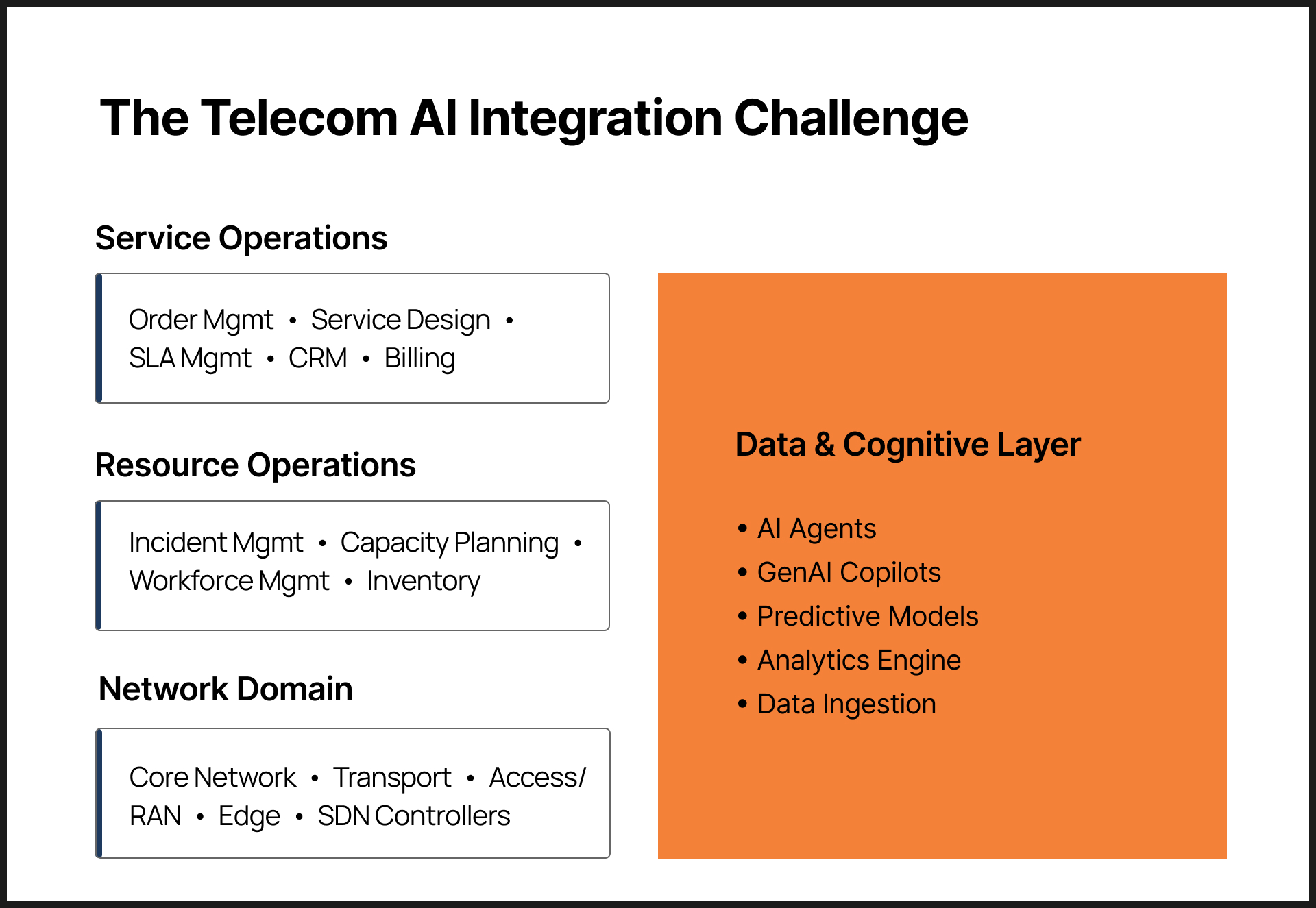
Telecom AI pilots stall because production environments introduce challenges in architecture, data integration, ownership, and ROI alignment that do not exist in controlled demos. These operational constraints, not model performance, are the primary barrier to scale.
Boston Consulting Group’s frames AI success not mainly as an algorithm problem but also a data, process, and organizational problem. In telecom, that operational layer is where scale usually breaks down.
Obstacle #1: Decades of technical debt
The first obstacle is architecture. Telecom environments run on layers of systems built over decades. OSS platforms manage inventory and provisioning. BSS platforms handle billing, CRM, and order management. These systems often come from different vendors, follow different data models, and were not designed for AI-native workflows. IBM research indicates two-thirds of communications service provider executives see data integration as their top challenge, while more than half point to legacy infrastructure.
Obstacle #2: Operational complexity
The second obstacle is operational complexity. A pilot can succeed with one clean data feed and one narrow integration. Production systems cannot. They need customer records from CRM, service configurations from OSS, billing data from BSS, and network telemetry from monitoring tools. Each connection adds latency, data quality risk, security requirements, and failure points. What performs well in a controlled demo can become unreliable inside live operations – one of the biggest barriers to scaling AI in telecom.
Obstacle #3: Too many owners, no real accountability
The third obstacle is ownership. In many telecom organizations, AI pilots begin in innovation, IT, or a business unit such as customer operations. Each group has different goals and different measures of success. Without a governance model that aligns them, pilots remain experiments instead of becoming operational systems.
Obstacle #4: The ROI Measurement Trap
The fourth obstacle is ROI discipline. A pilot that summarizes customer tickets can show a 30% reduction in agent research time. Impressive in a demo. But when leadership asks what that translates to in dollar terms across the full contact center, factoring in integration costs and change management, the math gets complicated.
Where AI should scale first in telecom operations
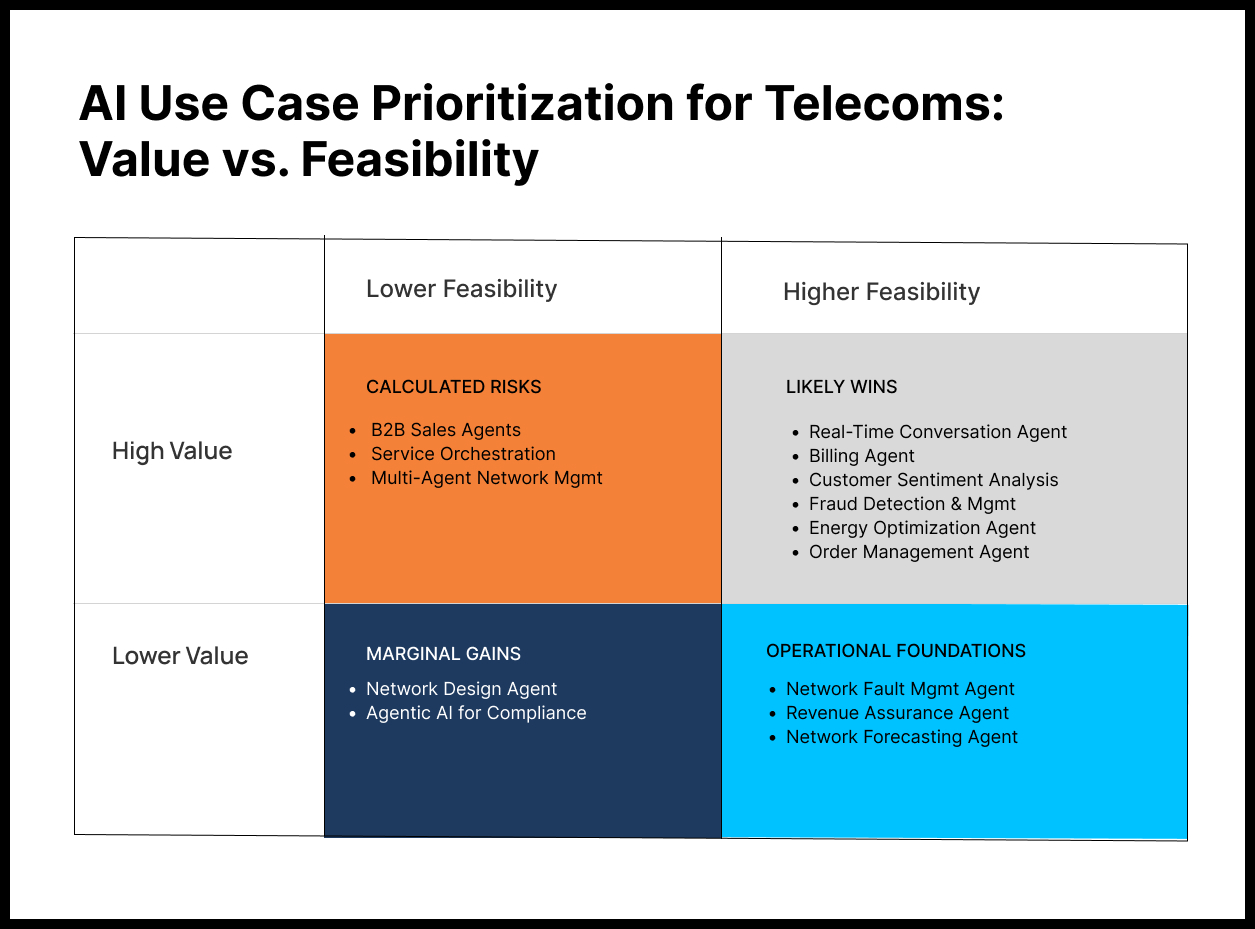
Adapted from Gartner AI Use-Case Assessment for CSPs (850725)
AI should scale first in telecom customer operations because it offers the fastest path to measurable business impact, supported by available data and clear operational pain points. This makes it the most practical starting point for scaling AI in telecom.
For most telecom operators, customer operations is the best place to move from pilot to platform.
Not because it is easy. Because it combines three things that matter: visible pain, usable data, and a direct path to measurable business impact.
Learn how agentic AI is being leveraged to unlock new growth opportunities in this deep dive article.
Gartner’s AI Use Case Assessment maps telecom AI on two axes: value and feasibility. The high-value, high-feasibility use cases are overwhelmingly customer-facing: conversation agents, billing agents, sentiment analysis, order management, and fraud detection.
This is also where the industry’s next AI shift is most useful.
The shift from chatbot to agent copilot
The first wave of customer operations AI focused on chatbots handling simple queries. The next wave is different. AI copilots sit alongside human agents, not in front of customers. They pull history, summarize interactions, suggest actions, and auto-generate case notes.
A perspective worth considering: the biggest unlock in telecom contact centers is rarely the AI model itself. It is the moment an agent opens a customer record and the system has already pulled the last three interactions, flagged the open network issue affecting their area, and drafted a recommended response. That is when handle time drops. Not because the AI replaced the agent, but because the agent stopped searching and started solving.
Intelligence across the full journey, not just one touchpoint
The real shift is embedding intelligence across the entire customer journey. When a customer calls about a billing dispute, the AI should already know their payment history, plan changes, and open tickets. When the issue involves a service degradation, the system should correlate complaints with network telemetry and flag the root cause automatically.
The best call is the one that never happens
The most cost-effective interaction is the one that never reaches an agent. AI-powered self-service portals, proactive notifications, and predictive issue detection can intercept problems before customers pick up the phone. Predictive churn models trigger retention workflows before customers consider switching. Personalization engines surface the right offer at the right time.
This is where the concept of a self-healing customer journey becomes practical. Instead of waiting for complaints, the system identifies issues, assesses impact, applies fixes where possible, and notifies customers proactively. The contact center becomes a last resort, not a first touchpoint.
The Network Data That Feeds It All
None of this customer intelligence works in isolation from the network. Network operations generate the data volume that makes telecom AI possible. Predictive maintenance has held the number one spot in industry AI conversations for three consecutive years according to Gartner.
Most operators sit in the middle of the maturity curve: deploying copilots, anomaly detection, and single-domain automation. The aspirational targets like intent-based networking remain years away. But the network data pipeline being built today is exactly what feeds the customer-facing AI systems. Network intelligence and customer intelligence are two halves of the same operational brain.
To make the successful shift from infrastructure to intelligence, read about these 7 trends that telecom operators should stay on top of in 2026.
Governance: The Missing Layer in Scaling Telecom AI
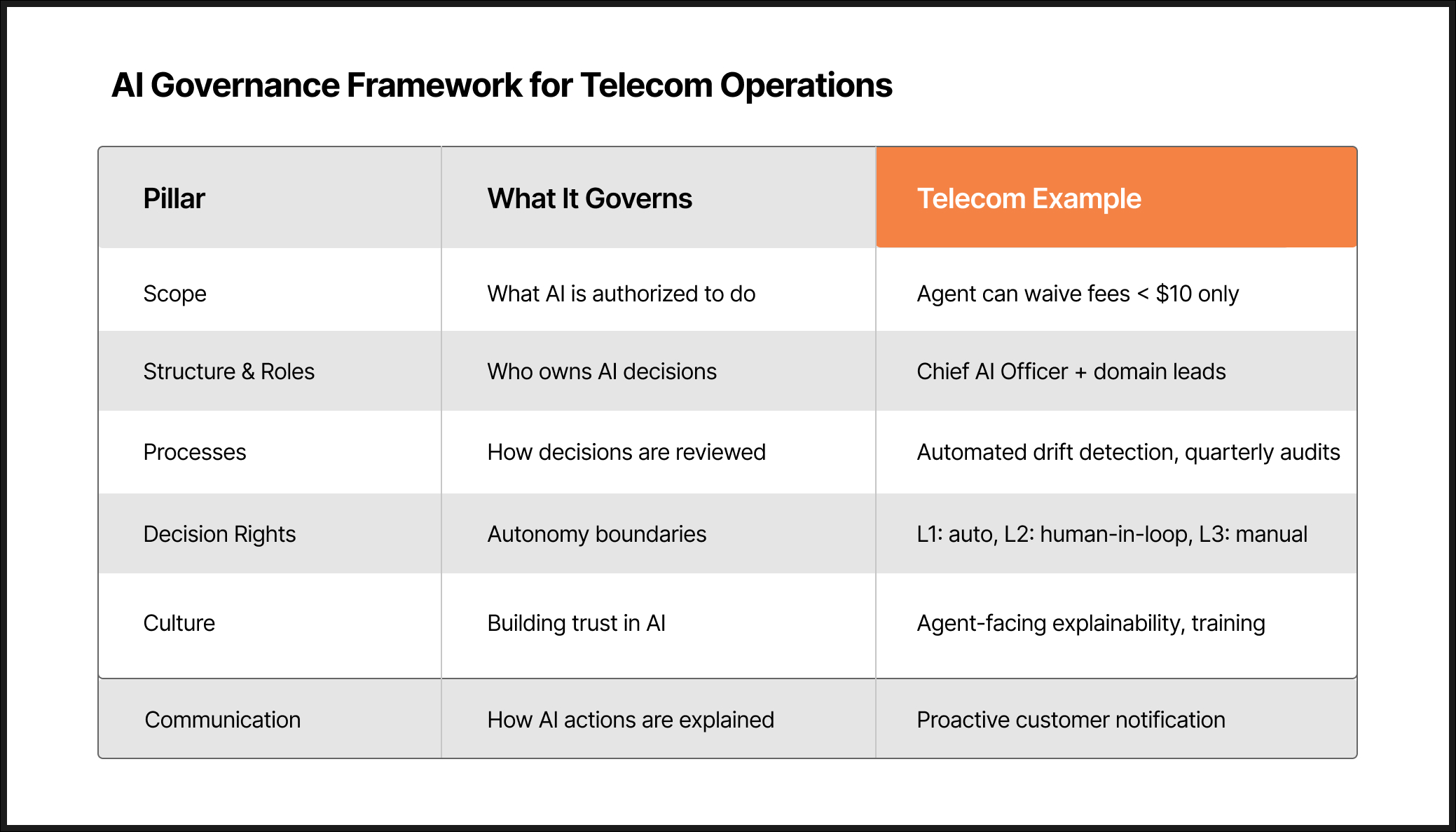
Governance is the missing layer in telecom AI because it defines how systems access data, make decisions, and are monitored over time. Without governance, AI cannot scale safely or deliver consistent business outcomes.
At scale, the telecom AI problem becomes a governance problem.
Data integration requires governance. Stakeholder alignment requires governance. ROI measurement requires governance. Production AI is not just a technology stack. It is a system of decisions, permissions, reviews, and accountability.
Three governance priorities stand out.
1) Decision rights for AI agents
A billing agent that waives a $5 late fee autonomously is different from one restructuring a $50,000 enterprise contract. The boundaries need to be explicit before deployment.
2) Continuous performance monitoring
Model accuracy degrades as customer behavior and network conditions change. Without drift detection and retraining protocols, a well-performing system becomes a liability within months.
3) Regulatory compliance baked in, not bolted on
Canadian telecoms operate under CRTC oversight and PIPEDA privacy requirements. Governance frameworks must encode these into the system’s operating parameters, not treat them as an afterthought audit.
A Practical Framework for Productizing AI in telecom
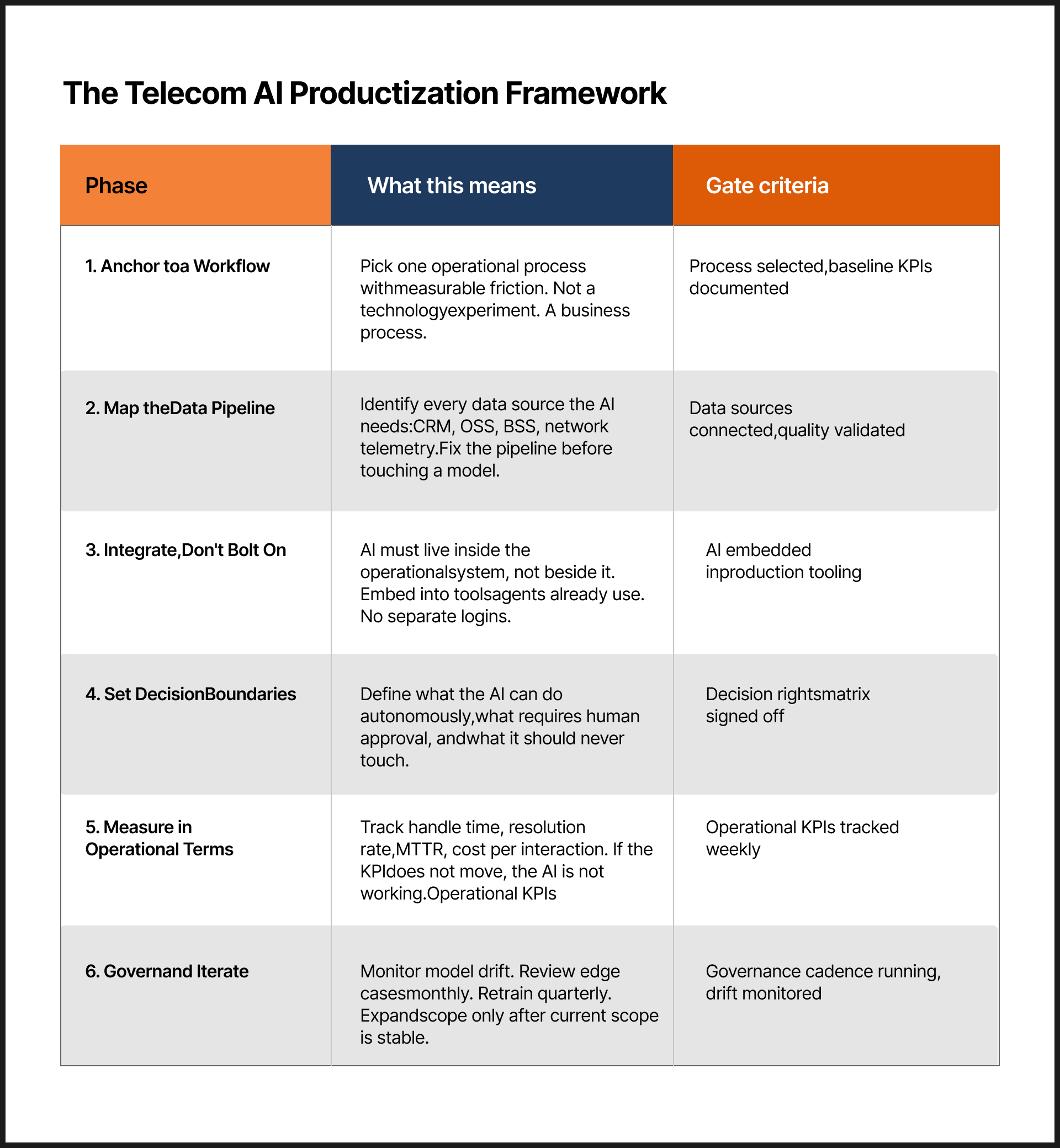
Across telecom operations, customer experience, and AI delivery, the same failure pattern can be observed:
Teams start with the model instead of the workflow. They build AI in isolation and then try to stitch it into production. They scale before governance is in place. Each time, the result is the same: a pilot that looks great in a steering committee deck and never makes it to an operational dashboard.
Moving from AI pilot to production requires a structured framework that prioritizes workflow selection, data integration, governance, and measurable outcomes. Without this sequence, most pilots fail before reaching operational scale.
Start with one workflow. Pick a process with measurable friction, not a vague AI experiment.
Map the data pipeline. Identify the required sources across CRM, OSS, BSS, and network telemetry before touching the model.
Integrate into production tooling. AI should live inside the systems agents and engineers already use.
Set decision boundaries. Define what the system can do autonomously, what requires approval, and what it should never do.
Measure operational outcomes. Track business and service metrics, not model accuracy in isolation.
Govern and iterate. Monitor drift, review edge cases, retrain on a defined cadence, and expand only after the current scope is stable.
Why the Sequence Matters
Most failed pilots skip straight to phase 3 or 5. They integrate AI into a system before understanding the data pipeline. Or they measure model accuracy without connecting it to operational outcomes. Every phase builds on the one before it. Skip one, and the whole thing unravels at scale.
This is a trap that telecom teams fall into repeatedly. An AI-driven ticket classification system gets deployed into the agent desktop. Accuracy is above 90% in testing. Agents reject it within weeks. The reason is almost always the same: the data feeding the model sits two systems behind the actual workflow. The AI classifies based on stale information, agents override it on every other ticket, and trust erodes faster than it was built. The model was never the problem. The sequence was.
The 5% of companies that successfully scale AI share a common trait. They start with the workflow, not the model. They identify a specific operational process, define measurable outcomes, build the data pipeline, integrate with production systems, and then apply AI to accelerate what already works. The model is the last piece, not the first.
The Cost of Standing Still
For North American telecoms, the competitive clock is ticking. The industry has spent four years moving from exploration to operationalization. That is four years of pilots, steering committees, vendor evaluations, and proofs of concept. At some point, the cost of continued experimentation exceeds the cost of committed execution.
Consider what happens to an operator that stays in pilot mode for another 18 months. Their competitors are embedding AI into agent workflows today, reducing handle time, deflecting contacts, and personalizing retention at scale. Meanwhile, the pilot-mode operator is still debating which use case to prioritize next. The gap is not just operational. It is structural. The operators that productize AI first will build data advantages, workflow muscle memory, and governance maturity that late movers cannot replicate quickly.
Final Takeaway: The Next Competitive Gap in Telecom AI
The next competitive gap in telecom AI will be operational execution, not model capability. Operators that successfully embed AI into workflows will outperform those that remain stuck in pilot mode.
The industry has already spent years in exploration mode. The more important question now is not whether AI can help telecom operations. It can. The question is which operators can turn AI into repeatable operating capability.
It is reasonable to expect that over the next several years, AI will become more deeply embedded across service, customer, and network workflows. But that outcome will depend less on model novelty than on execution: workflow design, integration quality, governance discipline, and operational measurement.
The telecom operators that make that shift successfully will not be the ones running the most pilots but those who can scale AI in telecom into production systems.
FAQs
What does scaling AI in telecom mean?
Scaling AI in telecom means moving from isolated pilots to production systems embedded in real operational workflows, with measurable business impact.
Why do telecom AI pilots fail to scale?
They fail due to integration challenges, legacy systems, lack of governance, and weak alignment with business metrics.
Where should telecom operators start scaling AI?
Customer operations is the best starting point because it offers clear ROI, strong data availability, and measurable operational improvements.
What role does governance play in telecom AI?
Governance defines access, decision rights, and oversight, ensuring AI systems operate safely and consistently at scale.
How can telecom companies successfully scale AI?
By focusing on one workflow, integrating data sources, embedding AI into tools, defining decision boundaries, measuring outcomes, and iterating under governance.