Key Insights
Treating AI as a tool means delegating it; treating it as infrastructure means redesigning the company
When leaders make that shift, AI stops being a project and starts changing how decisions get made, how risk is managed, and how products are built.
The real opportunity in this wave of AI is decision advantage, not automation
Moving cost from humans to machines is the wrong goal; the leaders pulling ahead are asking how to redesign their business so that intelligence compounds.
If you can’t tie AI to return on equity, the funding will eventually stop
CFOs and treasurers need to see AI framed around revenue growth, cost structure, and risk reduction, not around capability demonstrations.
Most organisations measuring AI are measuring activities, not outcomes
Tracking prompts, users, and licences is a start, but the next push is tying AI to operating leverage through metrics like decision velocity and time to insight.
Innovation without empathy is efficiency without trust
In banking, trust is the product, and AI has to make customers feel confident and connected, not just processed faster.
Episode Highlights
The ROE frame for CFOs
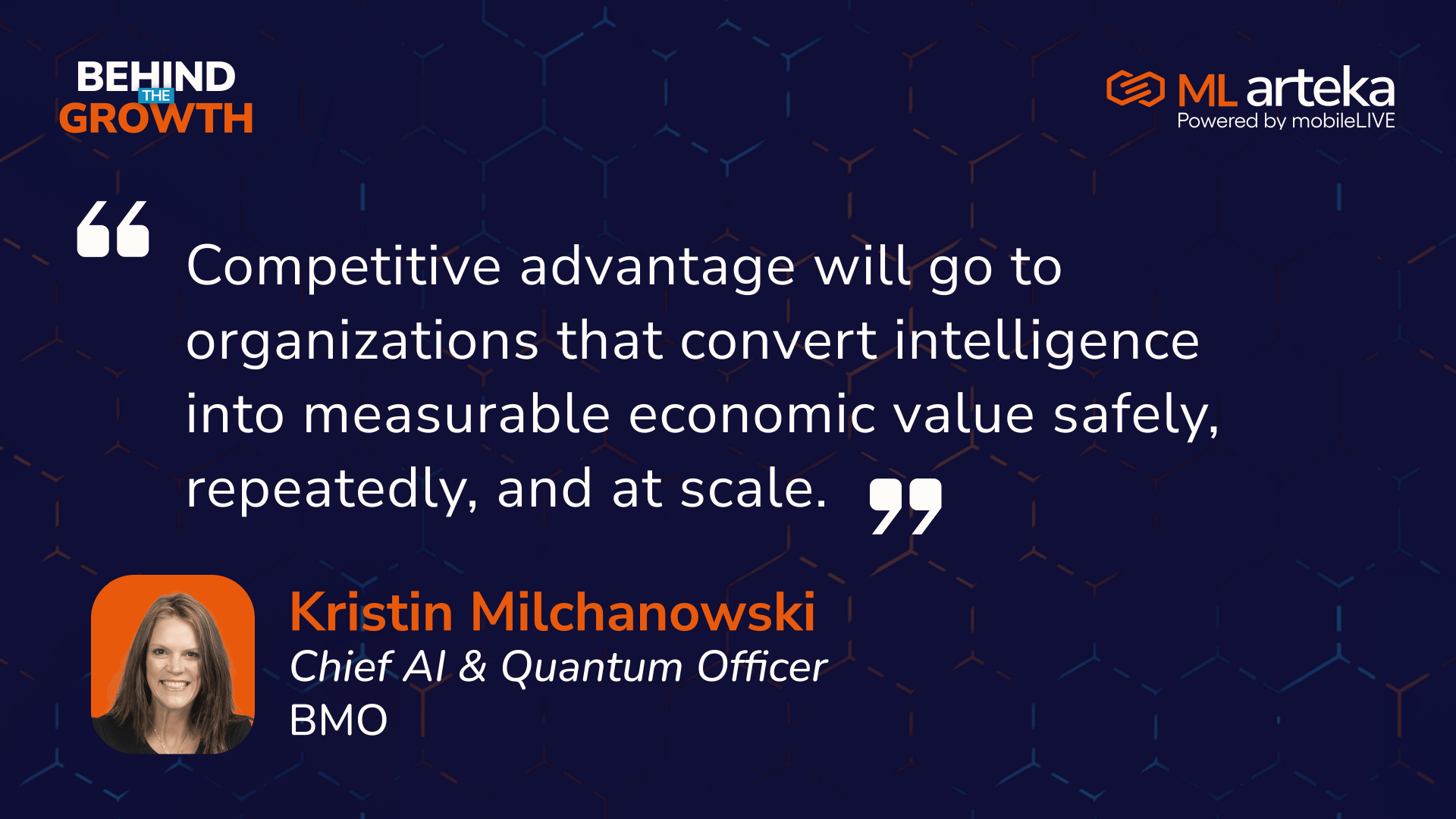
Getting budget for AI means speaking the language of the people who control it. Kristin’s approach is to stop asking “what’s our AI strategy” and start asking where AI will move return on equity. For CFOs and treasurers, the conversation has to be grounded in three things: revenue growth, cost structure, and risk reduction. Capability demonstrations don’t get funded. Operating leverage does.
“If you can’t tie that intelligence that you’re trying to build into your infrastructure to economics, eventually the funding will stop.”
Innovation without empathy is efficiency without trust
In banking, trust is the product. Customers put their assets into BMO because they trust the platforms, the bankers, and what the institution stands for. AI can make things faster and less expensive, but only if customers still feel confident, connected, and personally treated. The institutions that win won’t just be the biggest ones. They’ll be the ones customers trust enough to let AI act on their behalf.
“Innovation without empathy is merely efficiency without trust.”
Giving every employee permission to eliminate a bottleneck
At BMO, generative AI tools and AI training have been rolled out to every single employee. The ask is simple: use it to remove one bottleneck from your work every month. Kristin’s view is that real transformation happens at the individual level, when people remove friction from their daily work. The ripple effect builds over time.
“We give them the permission to win, we give them the permission to eliminate a bottleneck every month in their process, we give them permission to redesign how they accomplish something.”
FAQ
What does it mean to treat AI as infrastructure rather than a tool?
When leaders see AI as a tool, they delegate it. Infrastructure is different. It forces you to redesign how the company actually works, including how decisions get made, how work moves, how risk is managed, and how products are built. It also surfaces everything you were able to ignore before: fragmented data, broken processes, unclear ownership.
How should organisations measure the value of AI?
Most organisations that are measuring anything are tracking activities: pilots, number of prompts, number of users, number of licences. That’s a start, but it’s not enough. The next step is tying AI to outcomes, specifically to operating leverage and return on equity. Kristin measures this through decision velocity: how much value are agents adding to customer conversations, to risk frameworks, to revenue per employee? Time to insight is another measure. The goal is to connect AI directly to business value, not just activity.
How do you get a CFO to invest in AI?
The key is framing the conversation around operating leverage rather than capability. Most AI conversations feel abstract to CFOs and treasurers, and abstract doesn’t get funded. The frame that works comes in three parts: revenue growth, cost structure, and risk reduction. Can you improve deposit growth? Can you reduce fraud? Can you improve underwriting quality? Can you shorten a cycle time? Those are the questions that lead to real operating leverage results, and that is the language CFOs respond to.
What is decision velocity?
Decision velocity is how Kristin measures the business value of AI. It captures the benefit of agents adding value to customer conversations, fortifying risk frameworks, and improving revenue per employee. Time to insight is one way to measure it. The broader goal is to move beyond tracking activities and start measuring how much better and faster decisions are being made, and what that is worth to the business.
Why is governance important in AI deployment?
Speed in AI deployment is not always a good thing, especially in regulated industries like banking. Kristin has made decisions to slow things down when governance, identity, or control layers were not ready. Her view is that governance is a partner, not a blocker. Every decision has to build on the trust an institution has already earned, and moving faster than your governance can support puts that trust at risk.
How is BMO approaching AI adoption across its workforce?
BMO has given generative AI tools and AI training to every single employee, with no one left out. The ask is to use it to eliminate one bottleneck from their work every month, whether that is technology related or not. The thinking behind it is that people resist AI when it feels like something being done to them. By giving employees the tools, the training, and the permission to redesign how they work, the goal is for them to feel that AI is being built with them, not at them.