




Make every experience intelligent.
We design and engineer experiences people can adopt easily in complex, regulated environments.
Is adoption your biggest roadblock?
It's easy to ship a screen that demos well. It's hard to ship one that changes how people work, especially with AI in the loop and a regulated environment around it.
Has your user journey become so fragmented that every new release turns into a risk event?
Is your design effort being measured just in screens shipped rather than actual behavior changed?
Are you stuck with years of bespoke configuration that nobody on your team can safely change?
Do disconnected ERP and CRM systems leave you with mismatched data and AI no one trusts?
Designed to be trusted
Adoption is where a lot of transformation quietly dies. We design and engineer the experiences people actually use, for complex, regulated, AI-powered systems where trust and usability decide whether the work pays off.
That means designing so users can understand and defend the answers AI gives them. It means advocating for the users in the workflow, so it holds up under real conditions. And it means tying every design decision back to a business outcome, governed with the same oversight as the rest of the delivery.
Experiences built for adoption
We pair data, AI, and automation with human-centered design, so the experience is smart enough to help and simple enough that people actually use it. Every decision traces back to a real workflow and a business outcome, not a guess about what looks good.
Intelligent customer and employee journeys
We use data, AI, and automation to power personalized journeys and intelligent self-service, so customers get answers faster and teams spend less time on the routine.
AI experience
design
Interfaces that make AI outputs explainable and controllable, so people adopt them.
Product design and engineering
From prototype to production-grade product, on the governed delivery model.
Self-service and automation
Deflect routine work to well-designed self-service that customers actually complete.
Design systems and accessibility
Consistent, accessible component systems that scale across teams.
What changes for you once our work is done
Higher adoption of what you've already built
AI features people trust enough to use
More productive teams and less manual effort
Self-service that deflects routine tickets
One consistent experience across channels
Design decisions tied to business metrics
Research first, governed throughout, designed for a user experience that lasts
Every experience is grounded in observed behavior, specced and governed so intent survives the build, and validated with real users before it goes live. Then we track adoption, so success is something we can show, not just claim.
Understand the real workflow
We observe how the work actually happens. We don't assume.
Spec the experience
Flows, states, and AI behaviors defined and traceable under Spec-Driven Delivery.
Modernize in wave
Value early, with quality engineered in at each layer.
Prototype and test with real users
Before we build, not after.
Engineer to production
So the design intent survives the build.
Measure adoption
And keep iterating against the outcome, not opinions.
Results, not promises
30%
increase in online and in-store
sales from AI recommendations
50%
faster checkout
Ready-to-use tools that de-risk the work
ProductArt
Your AI product-partner workspace that turns pasted research notes into structured requirements, organizes them into a roadmap, runs a daily standup, and pushes issues to Jira.
Friday Design System
A collection of open-source libraries and components to help you accelerate your front-end development for working with multiple brands.
For leaders judged on adoption, not launch
Chief Digital Officer
Digital Leader
"We rolled it out and almost no one is using it."
Head of Product
Product Leader
"It looks great in the demo and breaks in the field."
CIO / CTO
Technology Leader
"Our users don't trust the AI, so they route around it."
The questions leaders ask us
What does an intelligent experience mean in practice?
It’s a journey shaped by data, AI, and automation, so customers reach an answer faster and teams spend less time on routine work, with the AI explainable enough that people trust it.
How do you design AI features people will actually trust and use?
We make the output explainable and controllable. A user can see why the AI said what it said, override it, and defend it. Trust drives adoption far more than novelty.
How do you measure adoption?
We instrument the workflow, track real usage under real conditions, and tie it back to the business metric the experience was meant to move.
How do you improve adoption of software people avoid?
We start by watching how the work really happens, find where the system fights the workflow, and redesign around the person, then design the rollout so it sticks.
Insights for enterprise AI and technology leaders
Five Design-Led UX Steps to Reduce Telecom Churn
Customers do not stay for your bandwidth. They stay because it is easy, and every avoidable point…
Read more

Designing Transparent AI That Wins Telecom Loyalty
Seventy three percent of customers want to know when they are interacting with AI, and only 42…
Read more
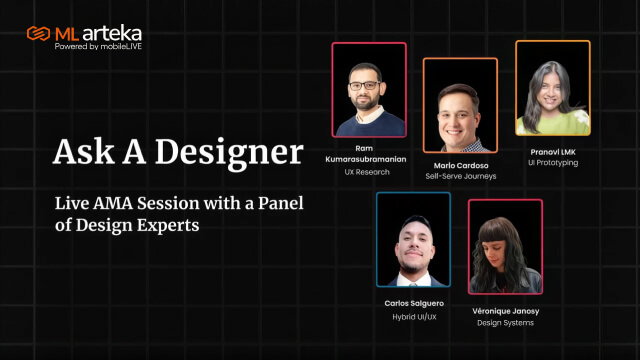
Ask A Designer: Live AMA Session with a Panel of Design Experts
On-demand Webinar Ask A Designer Live AMA Session with a Panel of Design Experts Good Design = Good…
Watch now