Key Insights
Go-to-Market Discipline Is as Critical as Product Quality
The product alone cannot carry a business. Even strong technology fails when there is no clear business justification or when the cost of selling is too high. Sharing this lesson he learned early on, Jyoti also notes that founders often focus heavily on building the product and only later realize that go-to-market is “the other half of the equation.” This underscores the importance of aligning product strategy with a realistic commercial motion. Strong engineering isn’t enough; scaling requires investment in customer validation, sales efficiency, and the operational structures that support adoption.
A Platform Succeeds Only When Every Component Is Best-of-Breed
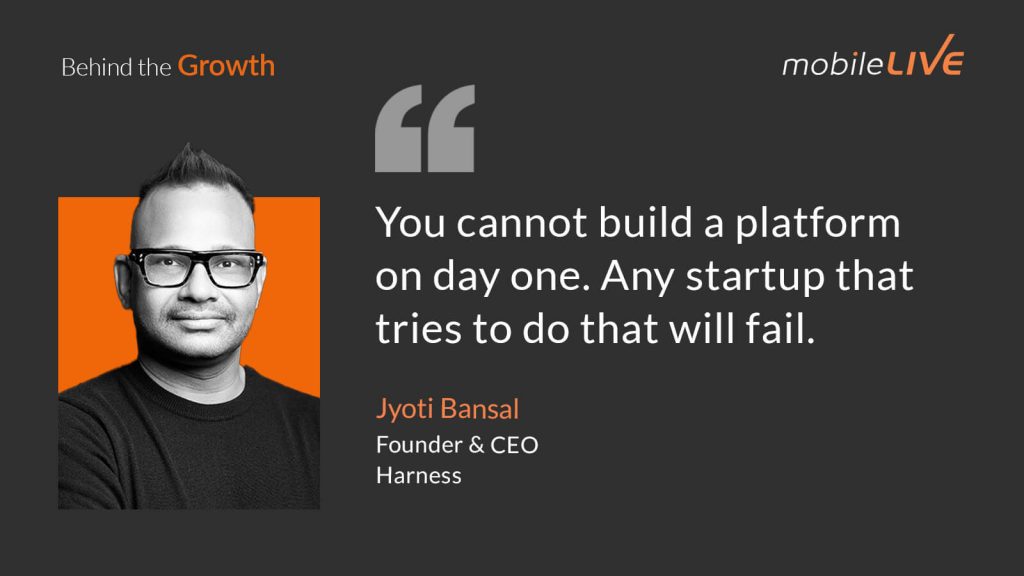
Enterprises don’t always need to make a choice between a platform or best-of-breed tools. Jyoti argues that customers want a platform, but only if each module is strong enough to compete with specialized point solutions. His own companies expanded only after succeeding in one focused use case, demonstrating that a platform must be built on top of proven components, not bundled mediocrity. For teams managing tool sprawl and consolidation, this is a critical lens to understand that a platform is viable only when each part stands on its own technical merit and delivers real competitive value.
Small, Autonomous Teams Increase Speed and Lower Experimentation Costs
Teams that own product quality, revenue, and customer success often keep the cost of experimentation low. Explaining how Harness runs on a “startups within a startup” system, each with a product leader acting as a startup CEO and a small engineering group, Jyoti emphasizes that such teams can launch early versions quickly and with fewer resources, sometimes with just one product manager and two engineers, especially with help from AI. This structure makes it easier to pivot or discontinue ideas that don’t gain traction. Autonomy, small teams, and clear accountability enable faster learning and smarter resource allocation in complex technology organizations.
Episode Highlights
The Decision That Changed Everything
Jyoti describes pitching early investors and facing repeated rejection, including questions about his lack of business experience. One investor challenged him directly, prompting a turning point in his journey. It’s a revealing look at how a single moment forced him to confront his own commitment and take action.
“There was one VC who asked me this thing, do you really believe in this thing? I said, yes, of course I do. So and he was like, why are you still in your job then?”
Realizing Product Isn’t Enough
While building AppDynamics, Jyoti realized that excelling in product is only half the work. He explains that founders often underestimate the importance of matching product quality with a strong go-to-market approach. This shift in understanding shaped how he built every subsequent company.
“Product is just half of the equation. Other half is go to market and you know, you got to the way you have to excel in your product, also have to figure out how to excel in your go-to market.”
The Platform Must Earn Every Module
Jyoti lays out his core philosophy for platform building: a platform only works when every component is designed to be best-of-breed. He rejects the idea that customers should accept weaker products just because they come packaged together, arguing that integrated platforms must still compete head-to-head with point solutions.
“You have to build a platform off best of breed. But can we have a platform that has all the pieces that are still designed to be best of breed that can compete with the best of breed point solutions?”
Why Harness Runs 16 Internal Startups
Jyoti describes how each product line at Harness operates independently with its own “startup CEO.” This structure creates ownership, accountability, and clear performance expectations—even within a large organization. It’s a transparent look at how he scales product innovation without losing focus.
“These are 16 startups inside Harness. And each of these startups have their like one product leader who’s kind of the, we call startup CEO.”
Failure Is Not a Punishable Outcome
Jyoti emphasizes that not every internal startup at Harness succeeds—and that this is an intentional, accepted part of how the company operates. He explains how teams may pivot, discontinue, or rebuild without fear of negative consequences, reinforcing a culture built around learning.
“Not all of them succeed. We’ll pivot them to something else. You know, sometimes we don’t continue them and all of that is okay.”